Professional leather cleaners in Dallas see the same seven problems on repeat. Not because leather jackets are fragile, but because most people do not know what the early signs look like or when a problem has progressed beyond what home conditioning can fix.
This guide covers all seven problems, what causes them, and what professional leather cleaning actually does that home treatment cannot.
The collar and cuffs of a leather jacket are in constant contact with skin. Body oils, sweat, and residue from hair products transfer onto those surfaces every time you wear them. Individually, none of those transfers amounts to much. Over months and years, the accumulation changes the texture of the leather and darkens it in a way that looks uneven against the rest of the jacket.
What makes this difficult is that the oils do not sit on the surface. Leather is porous, and oils can be absorbed through the grain. By the time the discoloration is visible, the contamination is already deep. A damp cloth does not reach it. Consumer leather cleaners are not formulated to break down body oil without drying out the surrounding leather in the process.
Specialists use pH-balanced degreasers designed specifically for leather porosity. The goal is to lift the oil from inside the grain without stripping the natural oils of the leather at the same time.
After cleaning, the area is conditioned to restore softness and match the texture of the surrounding leather. Caught early, the original color comes back. Left too long, the darkening becomes structural and permanent.
Leather stays supple because of oils, both those it retains naturally and those replenished through conditioning. Heat exposure, sunlight, dry indoor air, and time all pull out those oils. The jacket does not announce this is happening. It just gradually stops feeling the way it used to.
The first sign is usually a slight stiffness when you flex the material at the elbows or chest. The second sign is a dull surface that no longer responds to light the way it should. If the leather has been dry for a long time, surface conditioning alone does not penetrate deeply enough to reverse the damage.
Professional leather conditioning uses heat-assisted treatments that open the grain and allow conditioners to penetrate at depth rather than coating the surface. The process also includes seam and panel inspection because dryness affects high-flex areas differently from flat panels, and each requires a different treatment pressure.
The result is even softness throughout the jacket, rather than a surface sheen over leather that remains stiff underneath.
A little rain will not ruin a jacket, but how the water dries matters enormously. When water evaporates unevenly, it pulls the natural oils of the leather toward the surface as it goes, then deposits them unevenly as the water disappears. What is left behind is a ring or spot where the oil distribution changed, which shows up as a lighter or darker patch depending on the finish of the leather.
Mineral content in water makes this worse. Hard water leaves behind mineral deposits as it evaporates, which sit in the grain and affect how light reflects off the surface. This is why water spots are sometimes visible even after the jacket dries completely and the leather feels fine to the touch.
The fix is not drying. It is restoration. Cleaners rebalance moisture across the entire surface so the oil distribution evens out, then remove mineral residue from the grain. The jacket is then reconditioned uniformly so the repaired area does not stand out against the rest. Trying to spot-treat water damage at home usually makes the boundary between treated and untreated leather more visible, not less.
Two things change the color of a leather jacket over time: what gets onto it from outside, and what gets pulled out of it from inside. Dye transfer happens when the jacket rubs against other materials. Dark denim is the most common culprit because indigo dye is not colorfast against leather. Certain synthetic bag linings and seat fabrics also transfer. The transferred pigment sits on top of the finish of the leather and does not respond to surface cleaning.
Fading is a separate mechanism. UV exposure breaks down the dyes used in leather finishing. It happens slowly and usually appears first on the shoulders and upper back, where sun contact is highest. Most people notice it when they compare the jacket to a photograph from a few years earlier.
Dye transfer removal requires solvents that lift the transferred pigment without affecting the leather's own color. It is precise work, and using the wrong product sets the stain rather than removing it. Fading is addressed through professional recoloring, which matches the original tone and is applied in thin layers so the result does not look painted.
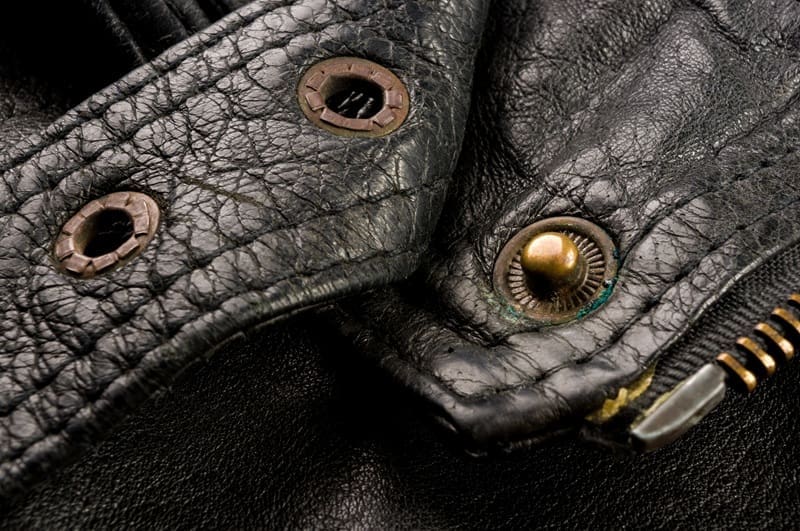
Cracking is the damage most people associate with neglected leather, but by the time visible cracks appear, the underlying problem has been developing for a long time. Leather cracks where it flexes most because that is where the oils deplete fastest. The elbow is the first place most jackets show this. Fine surface lines appear along the fold lines before any obvious cracking, and that is the stage where intervention actually works.
Once the leather has cracked deeply enough to separate the grain, no conditioner can fill that gap. The fiber structure has broken. At that stage, it is possible to slow further damage and use restorative compounds to reduce the visual severity, but a fully cracked panel cannot be returned to its original condition.
Early-stage cracking responds well to deep conditioning combined with leather filler compounds that flex with the material rather than sitting rigid in the crack. Professionals assess the depth of the damage before recommending treatment, because overapplying filler to shallow surface lines can yield worse results than doing nothing. The seams are inspected at the same time because cracking in the leather often signals stress on the stitching underneath.
Leather stored in the wrong conditions grows mold faster than most people expect. A sealed garment bag, a basement closet, a room with poor airflow during a humid summer: any of these creates the combination of moisture and low ventilation mold needs. It typically appears first as small gray or white spots on the surface or as a musty smell before the spots are visible. Once it starts, it spreads.
Mold on leather is not just a cosmetic problem. The fungal growth breaks down the surface finish and, if left long enough, begins degrading the leather itself. The lining of the jacket is often more affected than the exterior because it is a textile that holds moisture more readily.
Surface mold removal is the easy part. The harder part is eliminating the spores that have penetrated the grain and treating the lining separately, since it requires different chemistry than the leather exterior. Professionals use antimicrobial solutions formulated to kill mold at the root rather than bleaching the visible spots off the surface, which leaves the spores active.
The jacket is then dried in a controlled environment and reconditioned. Proper storage guidance after treatment is part of the service because the jacket will mold again if stored in the same conditions.
Leather absorbs odor the same way it absorbs oils: through its pores, not just onto its surface. Smoke is the hardest to remove because it carries particulate matter that physically embeds in the grain. That is why a leather jacket worn around campfire smoke or cigarette smoke still smells weeks later, even after airing out. The particles are still there.
Storage odors are different but equally stubborn. A jacket stored in a cedar closet, a plastic bag, or near mothballs will carry that smell in the leather long after you remove it from storage. Spraying cologne over it does not help. It adds another layer to the smell rather than displacing it.
Odor removal in leather requires treating the source rather than masking it. Cleaners use ozone or activated carbon treatments in controlled chambers to neutralize odors at the molecular level, followed by deep cleaning to remove particulate matter embedded in the grain. The lining is treated separately. The jacket is then reconditioned because the cleaning process, however gentle, removes some surface oils along with the contaminants.
If your jacket shows any of the problems above, the right time to bring it in is before the damage worsens. The longer most leather problems sit, the more they cost to fix and the less of the original jacket you get back.
Visit any of our Dallas area locations or schedule a FREE Pickup and Delivery Service. We make the process straightforward from inspection to return.
Locations: Dallas and Richardson, TX