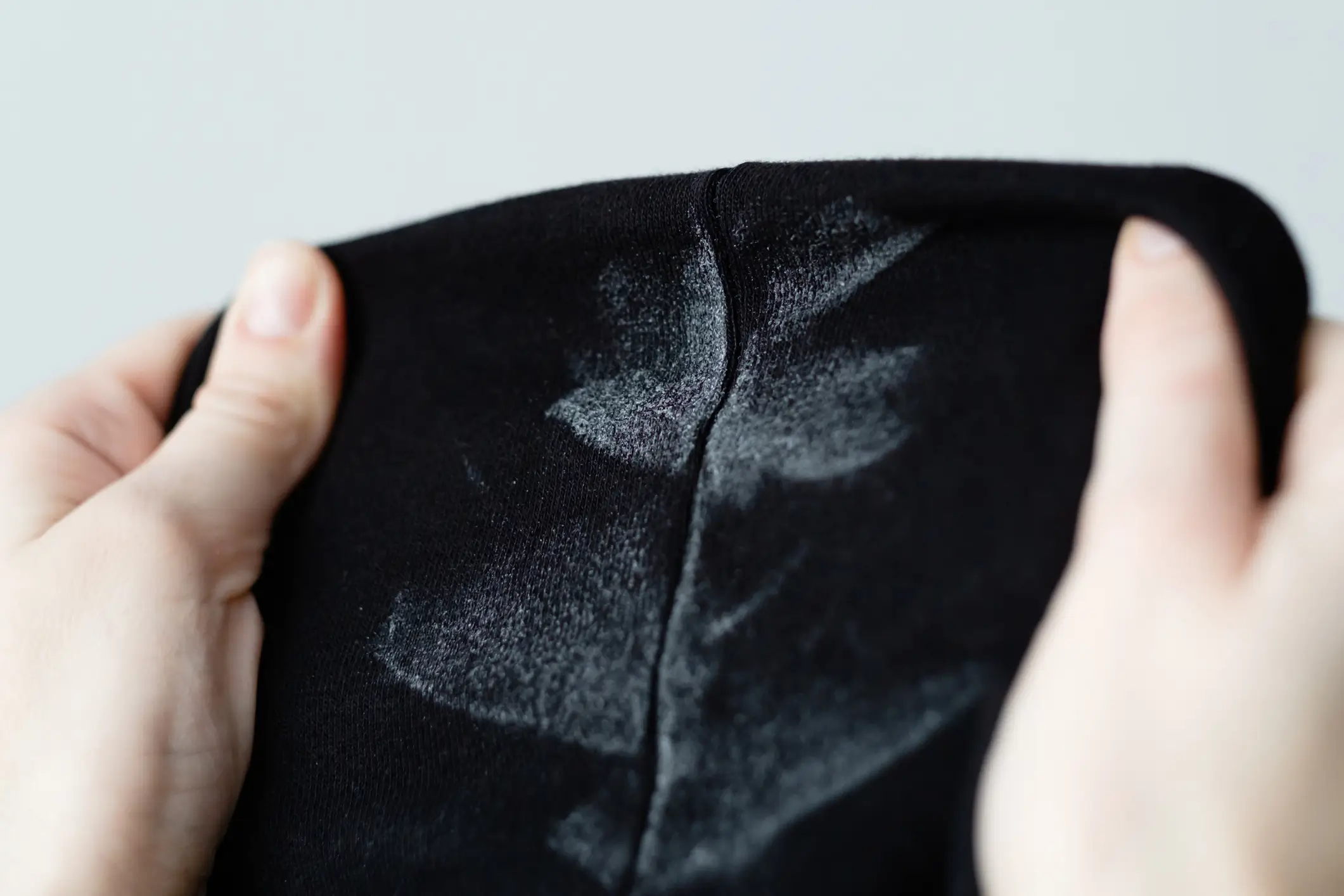
Streaks on dark laundry have a way of feeling personal, like you finally did the wash wrong. You didn't. What you see is residue that's been forming on every load, dark and light alike, and black fabric is simply the only place it's visible.
Once that clicks, the rest gets a lot less frustrating. From here, it's just a matter of tracing the residue back to its source, whether that's your detergent, your machine, or your water. A few adjustments at home, or the right Wash and Fold Laundry Service, usually clears it for good.
In the large majority of cases, streaking comes down to one thing: detergent that never broke down in the first place. Instead of dissolving into the water, small particles of it ride intact through the entire wash and rinse cycle.
When those particles land on fabric and dry in place, they leave behind the pale, powdery marks you see. Dark, flat-colored fabric just happens to show this the most clearly, which is exactly why black and navy items get blamed for a problem they didn't create.
Powder detergent needs a certain amount of warmth and movement to dissolve completely. Most machines default to cold cycles now, both to save energy and to protect fabric, but a cold wash often can't provide enough heat or agitation to fully break down powder. What's left behind are undissolved granules that ride the cycle from start to finish and end up exactly where you don't want them: stuck to your clothes.
A packed drum compounds the dissolving problem instead of fixing it. When there isn't enough room for water and detergent to circulate freely, two things suffer at once: the detergent can't fully break down, and the rinse cycle can't fully clear whatever residue forms. A machine working against a load that physically can't move enough water through it fights a losing battle before the cycle even finishes.
You don't need a scale to catch this. Open the lid or door mid-cycle, or just before you start it, and look for space. Clothes should tumble and shift freely, not sit packed against the drum wall. A simple test: if you can comfortably lay your hand flat on top of the load with room to spare, you're in good shape. If the drum is stuffed to the top, that's your answer.
It's an instinct: a load looks especially dirty, so you add extra detergent to compensate. The problem is your rinse cycle can only carry away a fixed amount of detergent, regardless of how much you used. Anything beyond that amount doesn't just disappear. It stays trapped in the fabric or redeposits back onto your clothes as they dry, which means more detergent often creates more streaking, not less.
Detergent doesn't clean in direct proportion to how much you use. Past the amount your water and load size can actually rinse away, extra detergent adds suds and residue, not additional cleaning power. Dosing to the load size marked on the cap, and adjusting only for water hardness rather than how soiled the clothes look, gets you a cleaner result with less left behind.
If you're in a hard water area, a second factor often works alongside the detergent issue. Minerals in the water can bind with detergent residue to form a film that behaves a lot like undissolved powder: it clings to fabric and shows up as the same pale streaking. That means some households deal with two overlapping causes at once, not just one.
A few signs point to hard water rather than detergent alone. Towels that feel stiff or scratchy even right out of the dryer are one clue. Colors looking slightly dull across your whole wardrobe, not just streaked in patches, is another. If you also see soap scum build up in your sink or tub, hard water is very likely part of what's landing on your clothes. Your local water utility can usually confirm hardness levels if you want to check directly.
None of these fixes requires new equipment. They just change a few habits that are working against you right now.
Most households notice a real change within two to three wash cycles. Residue doesn't build up as heavily once the underlying cause is addressed, so streaking tends to fade out gradually rather than disappear overnight. If you still see marks after a few cycles, it's worth checking if more than one cause listed above applies to your setup.
The clothes already sitting in your rotation don't need to be written off. Run them through a rewash with no detergent at all, using the warmest water setting the fabric allows. This strips out light residue that a normal cycle left behind. Repeating this once or twice usually resolves most cases without adding anything new to your laundry routine.
Items that see heavy daily use, such as towels and workout clothes, can build up years of residue that a single rewash won't fully clear. That's a capacity issue, not a sign you've done anything wrong at home. Commercial equipment moves a much larger volume of water through each load and extracts far more of it, which is the difference that finally removes deeply set residue for good.
A rewash at home clears light residue, but it has its limits. If your streaks keep coming back no matter what you adjust, that's usually a sign the buildup has gone deeper than a home cycle can reach.
That's exactly what our Wash and Fold Laundry Service is built to handle. At Mint Cleaners, we treat every load with the same priority, running the water volume and extraction your machine at home just can't match, so the clean actually holds, fold after fold, week after week.
Ready for laundry that stays clean, not just clean until it dries? Schedule a FREE Pickup and Delivery Service with Mint Cleaners today.
📍 Valley View Lane, Dallas, TX – 📞 (469) 874-0336
📍 Arapaho Road, Dallas, TX – 📞 (972) 803-3766
📍 Campbell Road, Dallas, TX – 📞 (972) 685-2090
📍 Preston Road, Dallas, TX – 📞 (214)-906-5721