That mental list – silk needs this, wool needs that, cotton can handle anything – stopped being useful a while ago. Almost nothing in your closet is a single fiber anymore, and a blend doesn't follow either fiber's rules cleanly. The tag sewn into the garment already accounts for that. It was made for the exact fabric in your hands, not a category.
Here's how to actually read that tag, five symbols at a time.
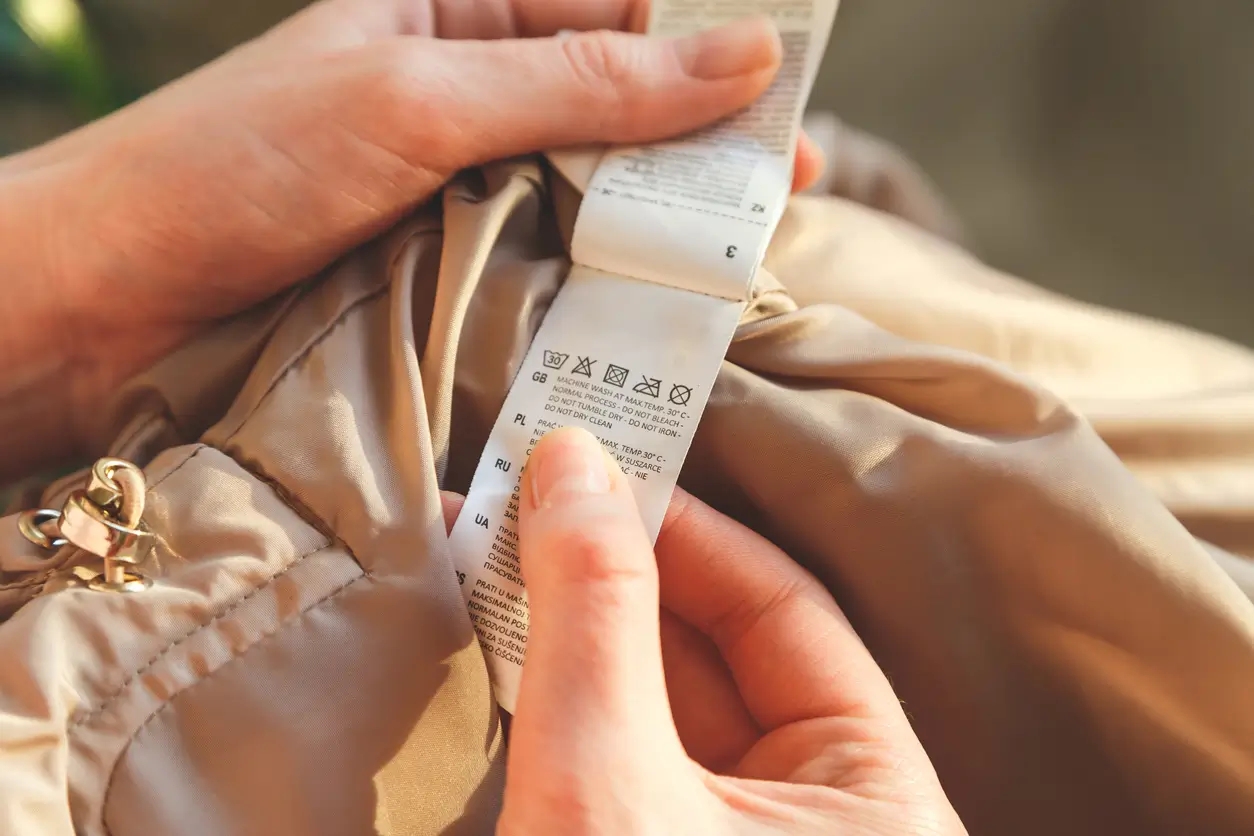
Every care label speaks the same visual language. Five icons cover washing, drying, ironing, dry cleaning, and bleaching. Learn to spot these five, and you can decode almost any tag in seconds.
A tub icon controls your washing machine settings.
Remember this one rule: More dots always means more heat, and heat is what damages fibers, elastic, and color the fastest.
The square icon tells your dryer what to do next.
Tumble drying is often more damaging than washing itself. Heat shrinks fibers, breaks down elastic, and sets stains permanently, so this symbol deserves just as much attention as the washing tub.
A small iron shape covers heat settings for pressing.
Ironing at the wrong temperature is one of the fastest ways to scorch a garment permanently, so treat this symbol as a hard limit, not a suggestion.
A plain circle signals professional cleaning territory.
This is the one symbol you're not expected to act on yourself. It's a message from the manufacturer to a professional, not to you.
A triangle shape governs whether bleach belongs anywhere near your garment.
Most modern fabrics can't tolerate chlorine bleach. If a label doesn't explicitly clear it, default to oxygen bleach or skip bleach entirely.
Once you notice the dot pattern in one symbol, you've cracked the code for the whole label.
The system is consistent across the entire label. Dots always represent intensity, and more dots always mean more heat or more aggressive treatment. One dot is always the gentlest setting available in that category, whether you're looking at the washing tub, the drying square, or the ironing icon.
One rule covers every symbol: when in doubt, choose fewer dots. Too cold just means a longer wash. Too hot can shrink it, bleed the color, or ruin the shape for good.
If a label is smudged, faded, or only partially legible, this is your fallback rule. Pick the lower number every time.
Labels get cut out, fade, or never existed to begin with. No label means you assess the garment itself.
Run through these four checks:
If you run through all four checks and you're still not confident, don't treat that uncertainty as a coin flip. Default to hand washing or professional cleaning. A garment with no label already came with less information than a labeled piece, so the margin for error should shrink accordingly, not stay the same.
Even when a label technically allows machine washing, certain construction details are strong warning signs that the garment won't survive the process the way you'd want.
Watch for these red flags before you load the machine:
A label reflects fiber content, not how the garment was built. A cotton blazer with structured shoulders and a lining is technically cotton, and cotton is often machine-washable, but the construction is what actually decides if it survives the wash. When the two disagree, trust construction.
Pure fiber garments are rare now. Most of your closet is a blend: cotton with spandex, wool with synthetic fiber, polyester with rayon.
The blend changes how you wash it, even if the label leads with cotton. A 95% cotton, 5% spandex tee needs cooler water than 100% cotton, because that small amount of spandex breaks down under heat far faster than the cotton.
When a label lists more than one fiber, always defer to the most fragile fiber's requirements, not the majority fiber. If a blend is 90% cotton and 10% wool, wash it like wool. The minority fiber is almost always the one that dictates the safe temperature ceiling, because it's the one that will show damage first.
Activewear and leggings carry unusually strict labels for a reason. Elastane, better known as spandex or Lycra, degrades fast under heat and certain detergents.
That cold water only tag isn't caution for caution's sake. It's the actual point where the elastic fibers break down and lose their stretch for good.
Heat isn't the only enemy here. Performance fabric traps body oil and sweat harder than natural fibers, so standard detergent often can't fully clean it. Cold water plus a detergent made for technical fabric beats hot water and regular detergent, for cleaning power and for the fiber's lifespan.
Once you know the symbols and the construction red flags, washing any garment becomes a process, not a guess.
Work through it in this order:
This works for any garment, new, secondhand, or hand-me-down with the tags long gone.
Not every decision comes down to what the label technically permits. Some garments are safer with a professional anyway.
Consider a professional cleaner for:
A laundry service exists for exactly this gap: what the label allows versus what you're comfortable risking. The label says what the garment can survive. You decide what's worth the risk.
Not every laundry service handles delicate or structured pieces the same way. Before trusting a professional with something irreplaceable, ask how they separate loads by fabric type, whether or not they inspect construction before cleaning, and how they handle stain removal on delicate materials. A cleaner who can answer these clearly understands garments the way this guide just taught you.
Reading care labels is a useful skill, but it's not the only way to guarantee a safe wash. Some weeks, the smarter move is handing your laundry to someone who already reads labels for a living.
That's exactly what we do at Mint Cleaners. Every load that comes through our Wash and Fold Laundry Service gets sorted, checked, and treated according to what each garment actually needs, not just what's convenient. Dallas-area households trust us to get it right, load after load.
Ready to stop second-guessing your laundry? Book your Wash and Fold Laundry Service with Mint Cleaners today.
📍Valley View Lane Location 📞 (469) 874-0336
📍Arapaho Road Location 📞 (972) 803-3766
📍Campbell Road Location 📞 (972) 685-2090
📍Plano Road Location 📞 (972) 644-6032
📍 Preston Rd, Prosper Location 📞 214-906-5721
Email: mintdrycleanersdfw@gmail.com